
What is the Coordinated Entry System (CES)?
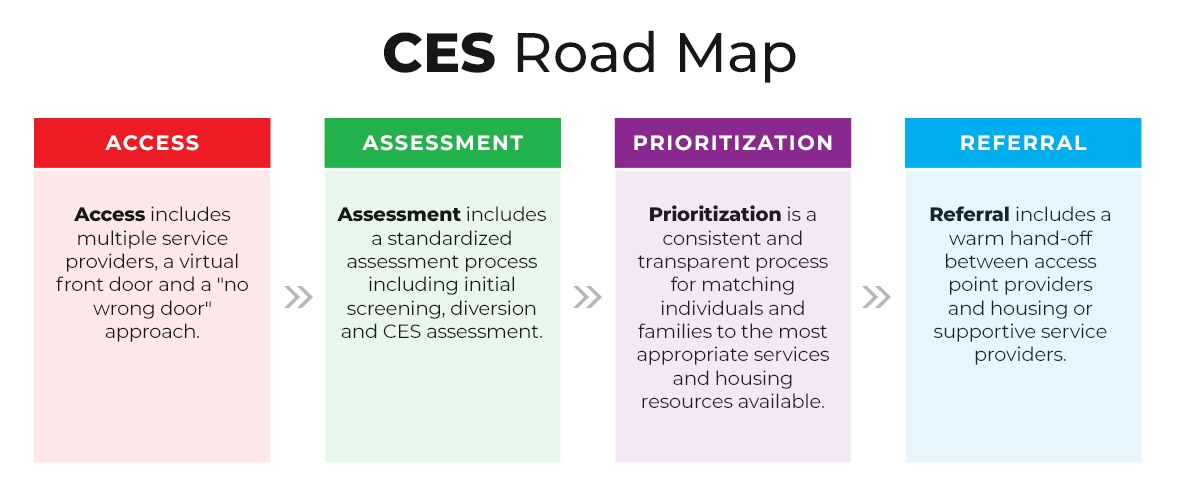
The primary goal of CES is to facilitate a participant-centered process that streamlines access to the most appropriate services and housing interventions for community members experiencing homelessness or at risk of experiencing homelessness in Orange County. The CES aims to meet individualized preferences and needs, with the goal of supporting these participants to return to stable housing. Community members experiencing homelessness and at risk of experiencing homelessness gain access to housing and supportive services more seamlessly through regionally coordinated access.
The CES promotes the use of diversion and solution-focused problem-solving strategies to effectively resolve a participant’s housing crisis at the point of engagement and during ongoing engagement with the CES collaborating agencies. CES collaborating agencies include County departments, nonprofit homeless service providers, and community-based organizations.
Who is Eligible for CES?
CES is for anyone experiencing homelessness in Orange County, including young adults, single adults, couples, families, veterans, seniors, and survivors of domestic and other violence.
What is the Bed Reservation System?
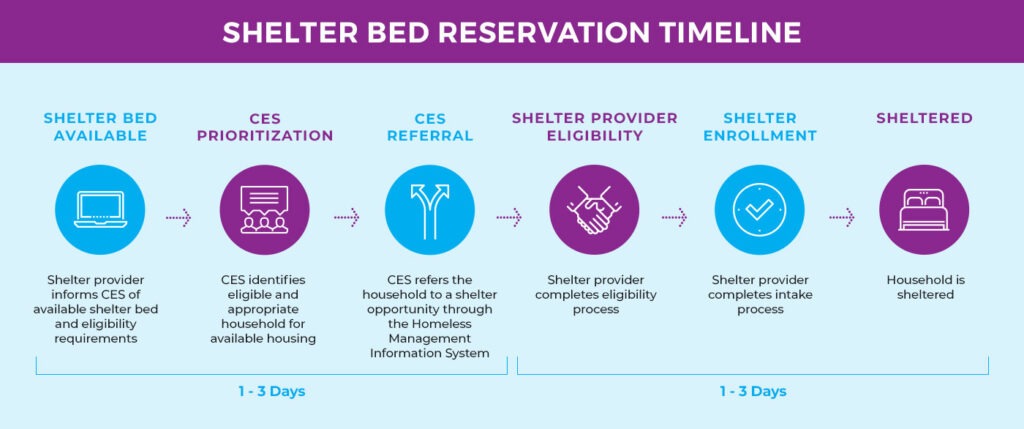
The Shelter Bed Reservation System for individuals (adult-only households) and families (households with minor children) leverages vital infrastructure provided by the Orange County Coordinated Entry System. The Shelter Bed Reservation System for individuals and families is operated by the OC CES Lead Agency and CES Operator, PATH. The Shelter Bed Reservation System is a centralized system where available shelter beds can be accessed by individuals and families experiencing homelessness.
The goal of the Shelter Bed Reservation System is to create a more streamlined and accessible process for individuals and families experiencing homelessness to obtain shelter and understand the availability of emergency shelter beds throughout the community.
Bed Reservation System FAQs
The Individual Coordinated Entry System currently provides referrals to three (3) Emergency Shelters through the Bed Reservation System.
Participating Shelters
North Orange County – Bridges at Kraemer
Central Orange County – Yale Navigation Center
South Orange County – Alternative Shelter Location (ASL)
The Family Coordinated Entry System currently provides referrals to nine (9) Emergency Shelter & two (2) Transitional Housing sites through the Bed Reservation System.
Participating Shelters
Family Assistance Ministries (FAM)
Gilchrist House – Emergency Shelter
FAMily House – Emergency Shelter
Aliso Viejo – Transitional Housing
Family Promise of OC
House of Ruth – Emergency Shelter
Homeless Intervention Services OC (HIS-OC)
HIS-OC – Emergency Shelter
HIS-OC – Transitional Housing
HomeAid operated by Mercy House
Family Care Center – Emergency Shelter
Illumination Foundation
Plumeria House – Emergency Shelter
Theriault House – Emergency Shelter
Murphy House – Emergency Shelter
Pathways of Hope
New Vista – Emergency Shelter
Additional Resources
Orange County Office of Care Coordination, CES Lead Agency


Scan to access the OC CES Resource Guide.
CES FAQs
What is the Community Queue?
After households are assessed by an Access Point and the required minimum documentation is collected, CES prioritizes households through Community Queues (CQs). The CQ is a tool that prioritizes and matches the most vulnerable households experiencing homelessness in our community with housing opportunities. This matching process is commonly known as a referral. Unlike a waitlist, the amount of time a household has been on a CES CQ does not affect priority. The priority factors considered for CES are explained under “How is the Community Queue prioritized?”
There are separate CQs for families (households with at least one minor and one adult), individuals (adult-only households), and survivors fleeing domestic violence.
How do I access CES?
To access CES, you can connect with a CES Access Point. A CES Access Point is an agency that serves as a point of entry to the CES program and provides additional assistance through referrals, services, and resources to address housing crisis needs. There are many CES Access Points throughout Orange County, including some that serve specific subpopulations.
If you are experiencing homelessness and are already working with a homeless services provider, ask whether they are a CES Access Point and whether they can connect you to CES. If the provider is not a CES Access Point, you may request a referral to one.
You may also call 2-1-1 to be connected to a CES Access Point. To view a list of CES Access Points, including their locations and contact information, click here.
For households with a child under 18, a pregnant person, or those working to be reunited with minor children, call 2-1-1and ask specifically about the Family Coordinated Entry System.
For households with a Veteran (who served in the U.S. Armed Forces, National Guard, or Reserves) who want to work directly with the U.S. Department of Veterans Affairs (VA) toward housing, you can also call the VA’s Santa Ana Community Resource & Referral Center (CRRC) at 844-838-8300, in addition to any of the other options.
Once connected to a CES Access Point, the CES Access Point will assess your housing needs and preferences, as well as the types of housing programs you may be eligible for.
What resources and programs are made available through CES?
There are three types of housing programs most commonly available through CES.
- Rapid Re-housing (RRH) programs provide time-limited rental assistance paired with time-limited supportive services. There is no minimum income requirement to participate in RRH. The goal of RRH is to increase or maintain income so you can continue paying rent after the rental assistance ends.
- Housing Choice Vouchers (HCVs), also commonly referred to as Section 8, offer tenant-based rental assistance (rental assistance tied to the tenant, not the unit), allowing the tenant to move between different units and properties. HCVs can be used to rent from a private landlord, and rent is often calculated based on household income. In some cases, an HCV may be tied directly to units within dedicated affordable housing properties. CES referrals to HCVs are separate from Public Housing Authority Section 8 waitlists for the general public, and you may be on both the CES and Section 8 waitlists.
- Permanent Supportive Housing (PSH) programs provide ongoing rental assistance with intensive supportive services. Participation in supportive services is voluntary. Households experiencing chronic homelessness are primarily prioritized for PSH.
CES also includes the Bed Reservation System, which is a Community Queue for available shelter opportunities at certain County-owned and/or funded shelters. This includes congregate and non-congregate shelters. Congregate shelters have large dormitory rooms and shared open spaces with limited individual privacy. Non-congregate shelters provide semi-private or private rooms or spaces.
After being entered into CES, what can I expect?
Once you are entered into CES, you are encouraged to stay in contact with your CES Access Point to obtain the documents needed for housing, such as identification (ID or driver’s license), birth certificate, Social Security card, income documents, proof of city residency, and other required documentation. This will help you and your CES Access Point complete a housing application if a housing match is made through CES.
Once all documents are collected, remain in contact with your CES Access Point at least once every 90 days to stay enrolled in CES.
Unfortunately, neither CES Access Points nor CES Administrators can provide an estimate of how long it may take to receive a housing referral. There is no guarantee that you will receive a referral to permanent housing through CES. Almost all housing opportunities matched through CES are prioritized for people experiencing chronic homelessness. The priority factors are explained under “How is the Community Queue prioritized?”
How is the Community Queue prioritized?
The Community Queue is prioritized under the CES Prioritization Policy, as adopted by the Orange County Continuum of Care Board, which considers the following factors:
- Chronic homelessness
- Disability status
- Length of homelessness
- Program eligibility criteria
- Chronic homelessness:
An individual is experiencing Chronic Homelessness if they meet either of the definitions below: Have accrued twelve months of continuous literal homelessness (with no breaks) AND have a documented disabling condition. Have accrued four episodes of literal homelessness over three years totaling twelve months AND have a documented disabling condition. - Disability status:
A documented disabling condition is required for prioritization in certain housing programs, including Permanent Supportive Housing (PSH) and for determining chronic homelessness. A disabling condition may include a physical, mental, or emotional impairment, developmental disability, substance use disorder, post-traumatic stress disorder (PTSD), traumatic brain injury (TBI), or other long-term condition that substantially limits one or more major life activities. Disability status must be verified through acceptable documentation in accordance with U.S. Department of Housing and Urban Development (HUD) requirements. - Length of homelessness:
Length of homelessness is calculated as the number of days since the approximate date a household’s most recent episode of homelessness began. Stays in an institutional setting (hospitals, treatment facilities, jails/prisons) lasting less than 90 days at a time do not constitute a break in homelessness. A “break” in homelessness is considered to be 7 or more nights during which the household is not sleeping on the street, in a place not meant for human habitation, or in a shelter. Length of homelessness is reported by CES Access Points to CES based on the information the household provides during the intake process. CES requires households to work with a CES Access Point to produce documentation verifying all episodes of homelessness in the last three years, at a minimum, to be prioritized appropriately. - Program eligibility criteria
Other factors in determining eligibility for specific opportunities include whether you are a senior, have a minor child, are a Veteran, the number of people in your household, and the city where you live or have ties (such as work, school, or receiving disability-related services). In addition, some housing opportunities are designated for individuals with a serious mental health disability.
What documents can be submitted to verify chronic homelessness?
- A Third-Party Certification Form for each episode of homelessness.
- A Disabling Condition Verification Form.
Please reach out to your SPA Administrator with any questions regarding specific situations or exceptions. All forms are located on the Orange County Office of Care Coordination, CES Lead Agency website. You may also refer to the HUD Toolkit for Documenting Chronic Homelessness.
What documents can be submitted as disabling condition verification?
Disabling Condition Verification must be provided by a state-licensed qualified source, which may include medical service providers, Licensed Marriage and Family Therapists (LMFTs), Licensed Clinical Social Workers (LCSWs), physicians, or other treating healthcare providers, as defined by the Social Security Act (42 U.S.C. Section 423).
Common examples include:
- County Disabling Condition Verification Form
- SSDI Award Letter
- SSI Award Letter explicitly stating the individual is disabled
- Written verification from a state-licensed qualified source that includes:
- License number and contact information
- Confirmation that the disability is severe and persistent
- Confirmation that the disability affects the individual’s ability to live independently unless suitable housing is secured
What can I do to support my CES Access Point and maintain my participation in CES?
To remain active in CES and continue to be considered for housing opportunities, stay in regular contact with your CES Access Point. If you do not have contact with a CES Access Point for 90 days or longer, you will automatically be removed from the CES Community Queue.
You are also encouraged to work closely with your CES Access Point to obtain the documentation needed for housing and to discuss your housing plan and other needs.
To ensure correct prioritization, work with your CES Access Point to ensure your length of homelessness and disability status are properly documented.
How can I find out where I am in the CES process?
If you have already been referred to the CES Community Queue, contact the CES Access Point that placed you on the queue, or the CES Access Point you are currently working with, for more information. If you cannot reach your CES Access Point, please contact 2-1-1 or the Office of Care Coordination at CoordinatedEntry@ceo.oc.gov.
How often is the Community Queue generated?
A new Community Queue (CQ) is generated every Friday afternoon. Any changes made in HMIS before Friday at 12:00 p.m. will be reflected in the following week’s CQ. Changes made after 12:00 p.m. on Friday will not appear until the subsequent week’s Community Queue.
Need Help?
If you or someone you know is at-risk of homelessness or experiencing homelessness, call 2-1-2 or go to https://211oc.org/ to be connected to a CES Access Point and/or speak with your service provider to find out if you are eligible for CES.
If your agency is interested in becoming a new CES Access Point and/or needs to update your agency’s information, please submit your new or updated CES Agency Agreement Form
Contact Us
Individual CES at ices@epath.org
Survivor CES at sces@epath.org
Family CES at fces@epath.org